

Preserving Ecosystem Services
With over 5,000 acres in conservation easements, AAM and its affiliates have established themselves as leaders in grassland conservation.


GRASSLANDS AT A GLANCE
A Critical Ecosystem
25%
The world’s grasslands cover approximately 25% of the Earth’s land surface (approximately 3.4 billion ha) and contain roughly 12% of the terrestrial carbon stocks.1
20%
Approximately 20% of the world’s grasslands have been converted to crops. Soil disturbance, such as cultivation, accelerates losses of organic matter.1
7.5%
7.5% of the world’s grasslands have been degraded.2 In the Midwest, many soils have lost 30-50% of carbon from conversion to agriculture.1
3 Gt CO2
The global potential for carbon sequestration from restoring degraded grasslands is significant, with the possibility to sequester ~3 Gt C per year.1
- 1 Ontl, T.; Janowiak, M. 2017. Grassland and Carbon Management. (June, 2017). U.S. Department of Agriculture, Forest Service, Climate Change Resource Center. Retrieved from https://www.fs.usda.gov/ccrc/topics/grassland-and-carbon-management.
- 2 O’Mara, F. P. 2012. The Role Of Grasslands In Food Security And Climate Change. Annals of Botany, 110: 1263–1270. Retrieved from https://doi.org/10.1093/aob/mcs209

DOING OUR PART
AAM & Conservation
California’s interior Coastal Range and Central Valley contain more than 11 million acres of grasslands.1 The State’s grasslands provide several ecosystem services, including wildlife habitat, watershed protection, open space, and climate change mitigation.1 As efforts to mitigate climate change ramp up, conservation organizations are increasingly investing in the protection of grassland ecosystems. Working with The Nature Conservancy and the California Rangeland Trust, AAM and its affiliates oversee easements protecting more than 5,000 acres of sensitive grassland habitat.
Credit: 1 Alvarez, P. 2011. Conserving And Managing Prairie, Grassland, And Vernal Pool Landscapes Through Collaboration. Fremontia, 39:2/39:3, 49. Retrieved from https://cnps.org/wp-content/uploads/2018/03/FremontiaV39.2_39.3.pdf
CONSERVATION EASEMENTS
Conserved in Perpetuity

CARBON OFFSET
Through conservation easements and responsible grazing practices, we are able to protect and improve the carbon sequestration capacity of our protected lands. This in turn, increasingly offsets the carbon footprint of our investment portfolio.

FUTURE GENERATIONS
Easements secure the protection of critical habitat for sensitive and endangered species, while ensuring that the ecosystems services that grasslands provide continue, in perpetuity, to thrive and benefit future generations.

AAM & INVESTORS
While conservation easements limit the ways in which land can be used, they offer attractive incentives that offset these limitations. With over a decade of experience managing conservation easements, we understand the value they provide.

REVERSING CLIMATE CHANGE VIA GRAZING
Mimicking the Grazing Patterns
of Wild Herds
Throughout the world, grasslands have evolved over millennia to support vast herds of roaming herbivores. These herds display spatial and temporal characteristics that are fundamental to grassland vitality. Without proper grazing, grasses do not effectively decompose. This presents a host of issues, including the release of carbon into the atmosphere, rather than carbon uptake in the soil, and desertification. Over the past few centuries, population numbers and densities of wild grazing animals have declined drastically as a consequence of human activity. In response, grasslands around the world are undergoing desertification. Grazing is now viewed as an imperative condition for maintaining the health of grassland ecosystems, and increasing carbon sequestration in soils. In California’s Central Valley, grazing promotes the vitality of the regions sensitive vernal-pool grassland landscape.
VERNAL POOLS
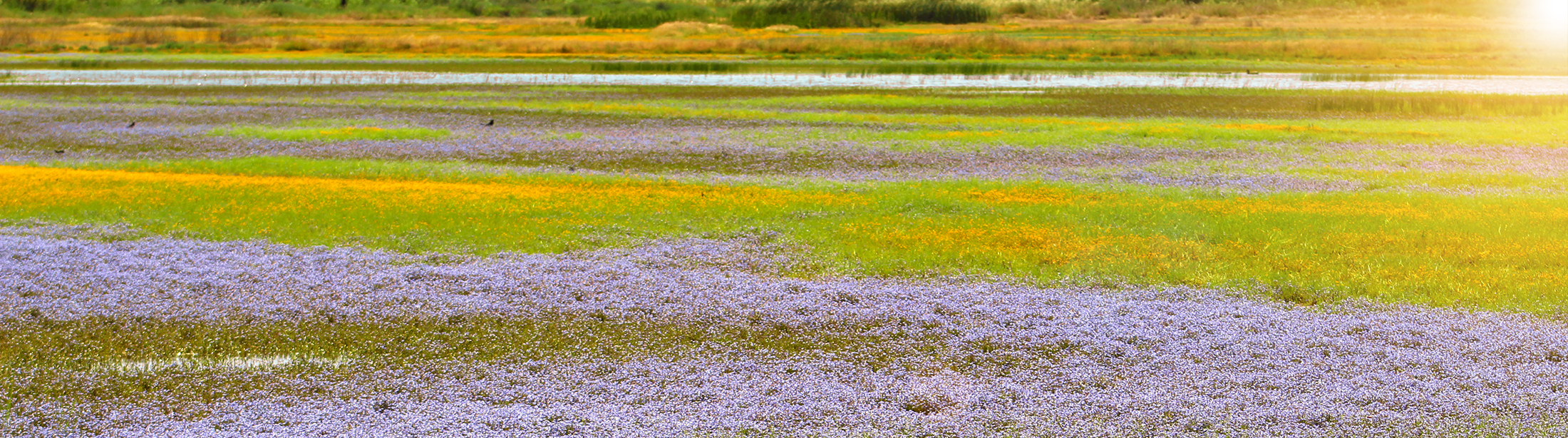
The Merced Grasslands, one of the largest and most intact vernal pool-grasslands habitats in the world, supports a unique assemblage of native species. The vernal pools, ringed by wildflowers in the spring, harbor a number of rare and endangered species. The pools also attract large flocks of wintering waterfowl and shorebirds in the rainy season. AAM’s efforts to conserve vast tracts of vernal pool grasslands has ensured the vitality of the ecosystem, and the safety of the unique and diverse species found within it.

Plants
The Merced Grasslands ecosystem hosts a variety of rare plants, including succulent owl’s-clover, Ewan’s larkspur, dwarf Downingia, pincushion navarretia, spiny-sepaled button-celery, hogwallow starfish, and San Joaquin Valley Orcutt grass.

Crustaceans
All of the minute crustaceans that inhabit the vernal pools are rare, including vernal pool fairy shrimp, midvalley fairy shrimp, California fairy shrimp, Conservancy fairy shrimp, and vernal pool tadpole shrimp.

Amphibians
The vernal pools provide a viable habitat for several species of amphibians, including the endangered California tiger salamanders, western toads, and western spadefoot toads.

Songbirds
Several species of unique songbirds can be found on lands owned and managed by AAM. These include, tricolored blackbirds, California horned larks, and savannah sparrows.

Raptors
Our lands provide suitable habitat for several different species of raptors, including bald eagles, prairie falcons, Cooper’s hawks, red-shouldered hawks, kestrels, and burrowing owls.

Mammals
AAM lands provide habitat to several rare species of mammals, including the San Joaquin kit fox, the San Joaquin pocket mouse, and the Merced Kangaroo rat.

WILDLIFE MANAGEMENT
A Natural Approach to Pest Control
AAM fosters robust populations of bird species, which in turn, enriches the natural landscape, while providing a natural approach to pest control.

CONTACT
- Archimedes Asset Management, Inc.
- 1400 Newport Center Dr.
- Suite 275
- Newport Beach, CA 92660
- USA

ARCHIMEDES ASSET MANAGEMENT, INC.
Through responsible real estate investment management we help solve some of the Nation’s biggest problems.
 © 2020 Archimedes Asset Management. All Rights Reserved.